
The country's m-cap is now 4.3x India's, whose m-cap grew just 17 per cent to $2.5 trillion in CY20 -- 2.4 per cent of the global m-cap.. Ashley Coutinho reports.

'For HNIs, shifting economic activities outside India by creating regional hubs for businesses is a better option.'

A December 28 board meeting of the Securities and Exchange Board of India (Sebi) may tighten norms for initial public offerings (IPOs). The board may look to prescribe a minimum 5 per cent gap in IPO price bands, extend the lock-in period for anchor investors to 90 days and cap the amount a majority investor can sell through offer for sale. The regulator is looking at whether there can be a preferred allocation for anchor investors who opt for a longer lock-in period, said a person familiar with the matter.

IT and ITeS companies accounted for $28.1 billion of the total investment pie during the first nine months of 2021.

The SME segment has been grappling with lack of liquidity and lacklustre institutional participation.

MFs have benefited from a shift to financial assets from physical assets like real estate and gold.

While the amount collected is a tad lower than last two years, it may surpass the previous two years' collections by the end of the year.

A normal monsoon, softer interest rates and inflation, pent-up demand, along with mild budgetary support may help growth pick up in coming quarters.

Infrastructure and real estate prominently feature as wealth destroyers.

'India's sizeable forex reserves should help stem a possible fall in our currency.'

Oil-to-telecom conglomerate Reliance Industries (RIL) has emerged as the country's largest wealth creator, adding a staggering Rs 9.6 trillion over the past five years, according to Motilal Oswal's 26th Annual Wealth Creation Study. In doing so, the Mukesh Ambani-led company has beaten its own record of Rs 5.6 trillion generated in 2014-19. The study covered financial year 2015-16 (FY16) to FY21 and ranks the top 100 companies in descending order of absolute wealth created, subject to the company's stock price outperforming the BSE Sensex. The firms were also ranked according to speed (price CAGR during the period).

'India has entered an economic super-cycle driven by a housing cycle turnaround.'

'The IPO market is cooling off and getting a reality check.'

'While the country has been hit hard from a strong second wave of Covid, we believe the markets are willing to look through that.'

Experts believe the new norms may be an indirect way for Sebi to apply the brakes on dividend option plans in MFs.

Do a proper asset allocation and invest through systematic investment plans where one can benefit.

'Then select those that are well-aligned with your risk-return profile and investment time horizon.'

'The years after the financial crisis of 2008 were tough for brokers as volumes dwindled and retail investors stayed away.'

Debt funds typically held 0-5 per cent of their portfolio in cash and cash equivalents before this Sebi diktat.

Outflows are likely to continue, experts say, till such time as the markets see a significant correction.

'Start-ups that generate a majority of their income in India are likely to opt for an Indian listing.'

While a little more than 140 penny stocks have doubled in value, 555 have given negative returns in the past year. Of these, 84 shed more than half their value.

'As valuations of large-caps appeared to be out of whack, investors started lapping up quality mid-caps and small-caps, which were available at relatively comfortable valuations.'

'It is going to be a tough balance for the RBI to manage economic stability and ensure smooth government borrowing.'

'Making money in such markets is typically harder and investors need to put in considerable effort to identify stock ideas over the year.'

A large proportion of passive funds has beaten actively managed large-cap funds with average one-year category returns for large-cap at 10.2 per cent

'Large-caps are better placed to withstand the impact of higher input cost inflation, rising rates and withdrawal of excess global liquidity.'

EM asset classes could rally if the pace of US Federal Reserve rate increases moderates.
Fund houses have conducted investor camps and awareness programmes in more than 400 cities. Also, the popular 'Mutual fund sahi hai' campaign has helped bring in a lot of new investors into the MF fold from underpenetrated regions.

Fund managers's compensation is largely tied to the assets they manage and scheme performance.

Indian equities are no longer cheap vis-a-vis global markets, and only a short distance away from being the most expensive they have ever been.

'... Whether an incumbent is voted back or a coalition forms a new government except for a temporary disruption for a few weeks.'

'Equities are likely to be range-bound with a downward bias for the remaining part of the year.'

'Periods of high volatility are usually bad for mid-caps and this is something that has to be kept in mind.' 'Focus on quality is of paramount importance.'

'They should decide their allocation based on their risk appetite and age, and not valuations.'

'If an investor is ready to stay put for the next five years, one can consider investing in mid- and small-cap funds, but through SIPs.'

Market regulator, the Securities and Exchange Board of India, has set out five broad categories for mutual fund schemes, including equity, debt and hybrid funds that will benefit investors, says Ashley Coutinho
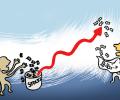
'The good news is that money continues to flow into India-focussed offshore funds.'

Market participants are hoping for a few tweaks on the taxation front which will encourage consumers and businesses to spend.

Ravi Gopalakrishnan, head-equities, Canara Robeco Mutual Fund, tells Ashley Coutinho that earnings growth will pick up once the benefits of reform initiatives accrue.
 © 2026 Rediff.com - Advertise with us - Disclaimer - Privacy Policy - Sitemap - Feedback - About us - Terms of use - Grievances